Claude Fable 5.2 came out today, and I wanted to know if it's actually good at the kind of work I do every week, not just benchmarks. So I gave it two real tickets on my personal site and let it run like it was any other dev on the repo. One backend ticket, one design ticket. I kept the transcripts, pulled the token counts from my Cursor usage page, and had a design bot score the UI before and after.
Short version: I'm really happy with it. The UI it produced is way better than what I've been getting just using Grok 4.7, and the second ticket cost me real money. Here's the whole thing.
The setup
The repo is my private admin site, a family-and-life dashboard I built for myself. It has a PTO page where I log time off against a yearly goal. My assistant bot already uses APIs on this site for things like vehicles and contacts, but PTO had no API, so a bot couldn't read or log it. That was ticket one. Ticket two was the PTO page itself, which honestly looked rough.
My assistant bot wrote both prompts. Each one set the done criteria up front: tests pass, follow AGENTS.md (including its rule that any UI change needs screenshots in the PR), don't merge, and keep an honest log in the PR of your plan, the decisions you weighed, and anything you got wrong and fixed. That last part was the real test for me.
Both runs were Cursor cloud agents with Fable 5.2 at high effort. And I did the whole test from my phone. I kicked off both runs, watched them work, and handled the reviews and the merges with Grok Bot and Cursor cloud agents, and I never sat down at a desk.
Run 1: the PTO API
The first thing it did surprised me a little. Before changing a single file, it ran the tests, lint, and a type check on main to get a baseline. 203 tests passing. Prettier was already failing on main, and tsc already had 38 errors on main. So when it finished, it didn't claim "types pass." It said there were 38 errors on main and 38 on the branch, the same set, none in new files.
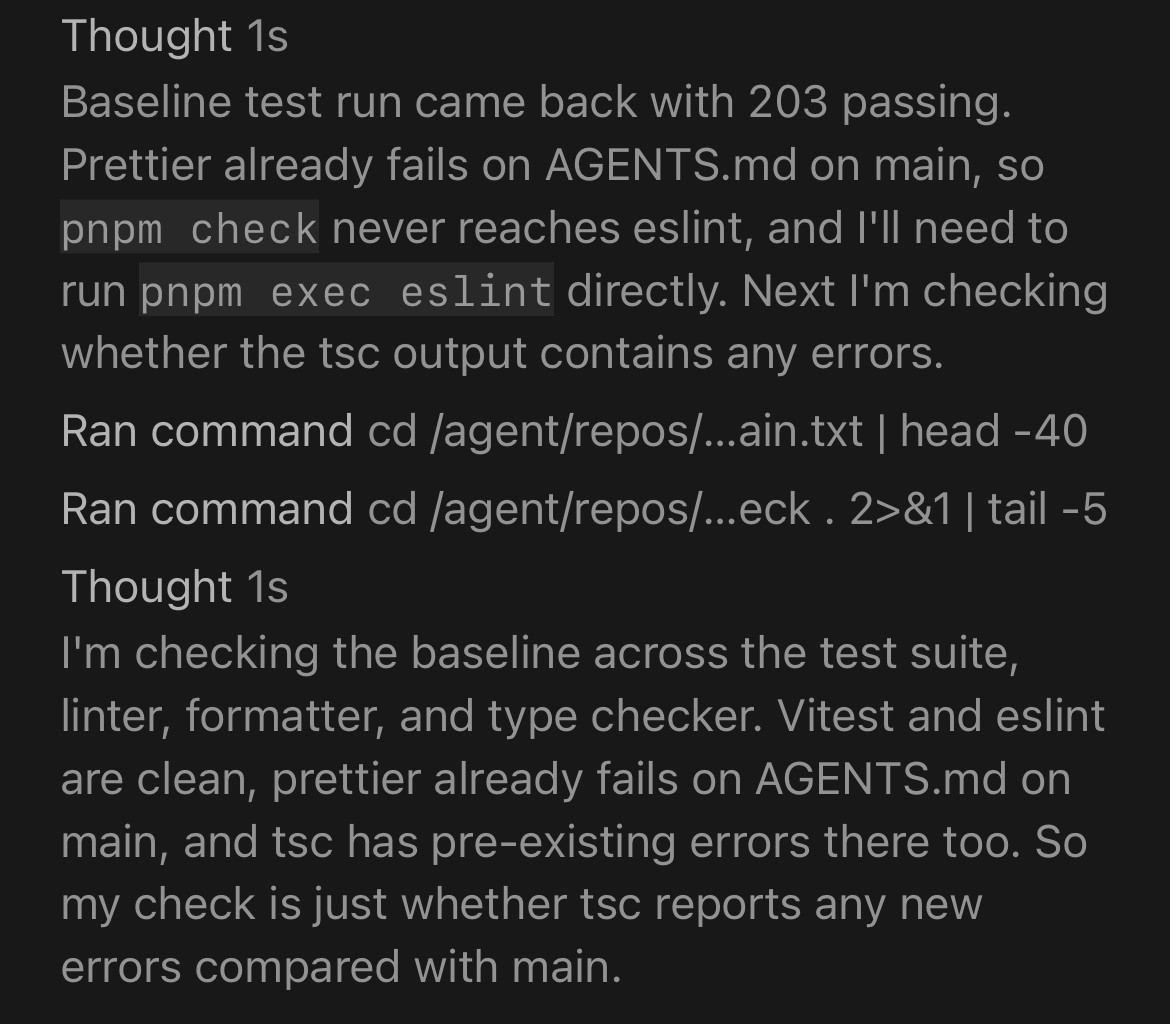
What it saw on main before touching anything. Straight off my phone, like every phone shot in this post.
Then came my favorite moment of the whole test. The issue I wrote asked for PTO "per person" with a "type." The database has neither. It just stores dates, days, a note, and a source, because it's my own log. Fable sat on that for 1 minute 21 seconds. From its thinking:
Adding person and type columns would change the goal math, the admin page, and the chat tools, and it's a one-way migration, so that's a product call I shouldn't make on my own.
So it didn't. It built the API against the store as it exists, made person, type, and notes come back as a 400 that names the field (so nobody thinks they logged someone else's time off), and used Refs #77 instead of Fixes #77 so the issue stayed open for me to decide. My spec was wrong and it caught it instead of quietly building the wrong thing.
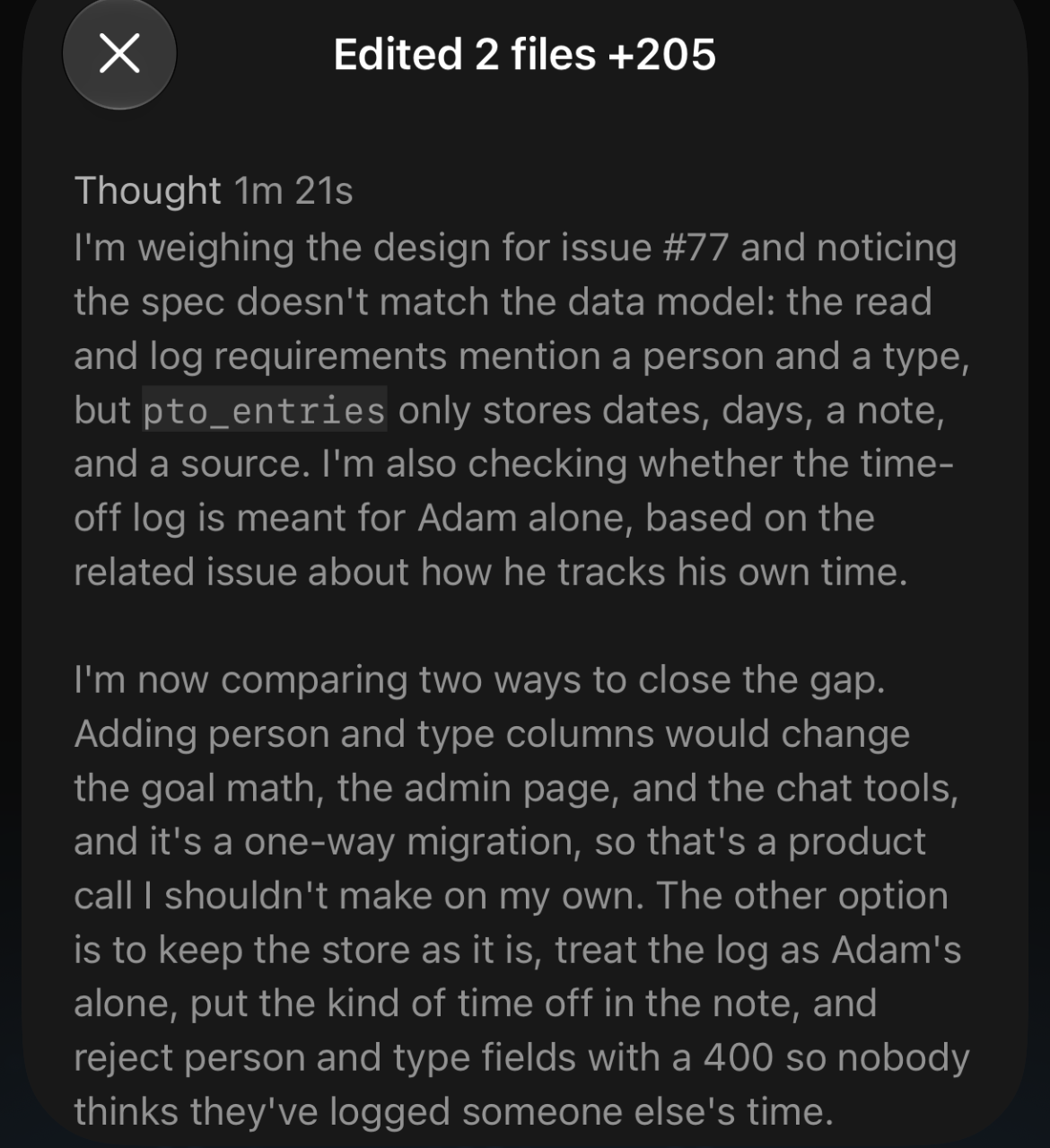
The 1m 21s thought where it caught that my spec didn't match the database.
It also found a bug nobody asked about. An impossible date like 2026-02-31 made the PTO validation throw instead of returning a nice error. It fixed that in its own commit with a test.
To prove its new tests actually catch things, it broke its own code on purpose three ways: put the old admin-only guard back, removed the date range fix, and let unknown fields through. Each one made tests fail, and it reverted them.
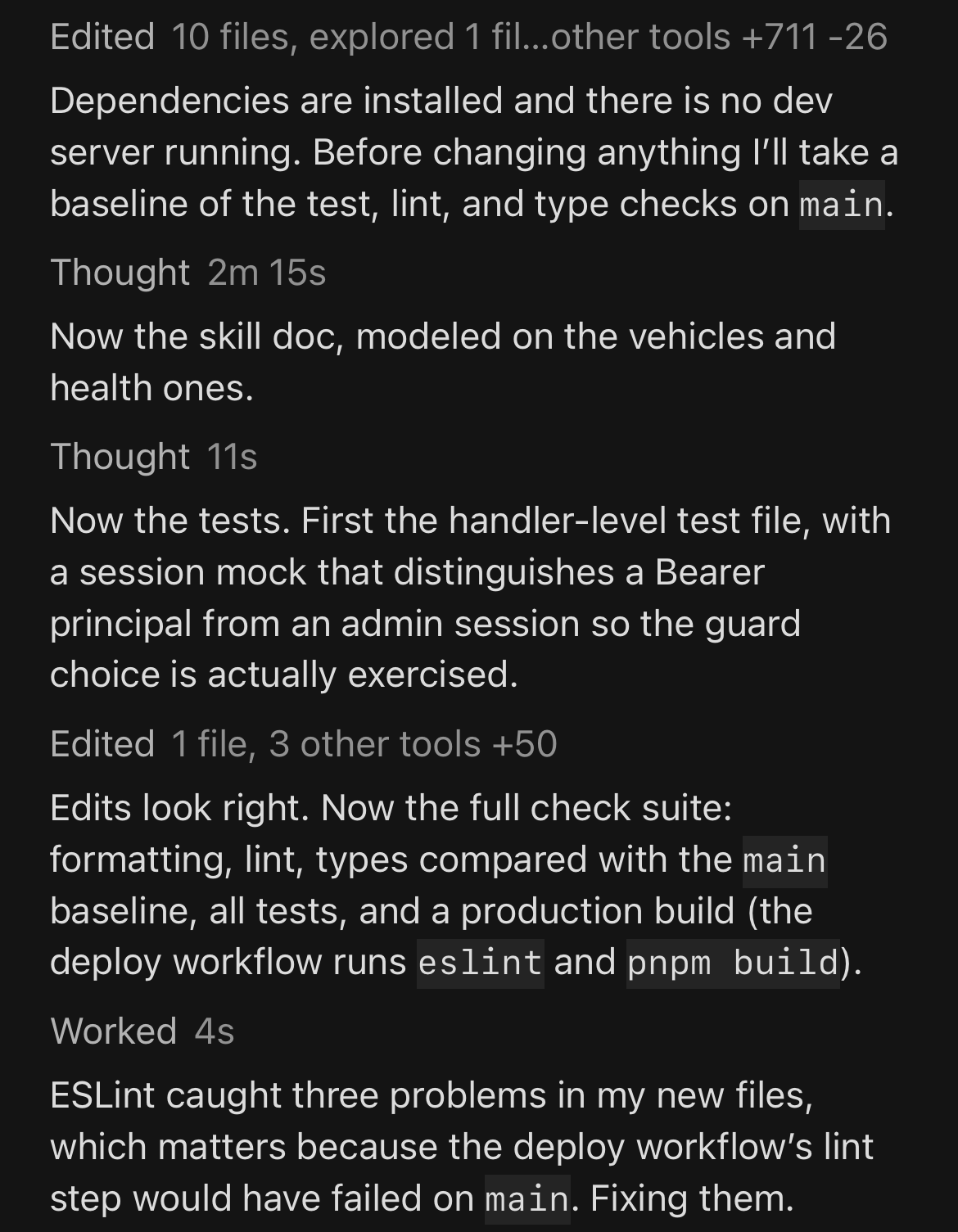
The middle of run 1. Tests built to actually tell a Bearer token from an admin session, then the full check suite, then ESLint catching three problems in its own code.
And the mistakes log was real. ESLint failed on its new files three times and it restructured the code instead of disabling rules. It rewrote a test file that had broken escaping. It exported something it didn't need and reverted that. My favorite one: its production build check came back with an empty list, and it figured out that was its own test setup (the rows were still sitting in the SQLite WAL file when it copied the database), not a bug in the API. It reran against a fresh database and said so.
Final tally: about 25 minutes, 150 tool calls, +1163/-42 across 35 files, tests went from 203 to 221. I merged it.
Run 2: the redesign
For the design side, I have a design-review bot I built that scores UI out of 10 across typography, hierarchy, spacing, color, iconography, polish, and clarity. I had it review the old PTO page first. It gave it a 5.8 and wrote up 10 issues. The biggest one: the page said "Used 25" but that number mixed days I'd actually taken with days I'd only booked. There was a cryptic summary row, a twelve-row table taking up a full screen to show 12 numbers, a red DELETE button on every single row, and ISO dates everywhere.
That review became the brief for run 2. Fable got the 10 issues and the screenshots and was told to fix the page.
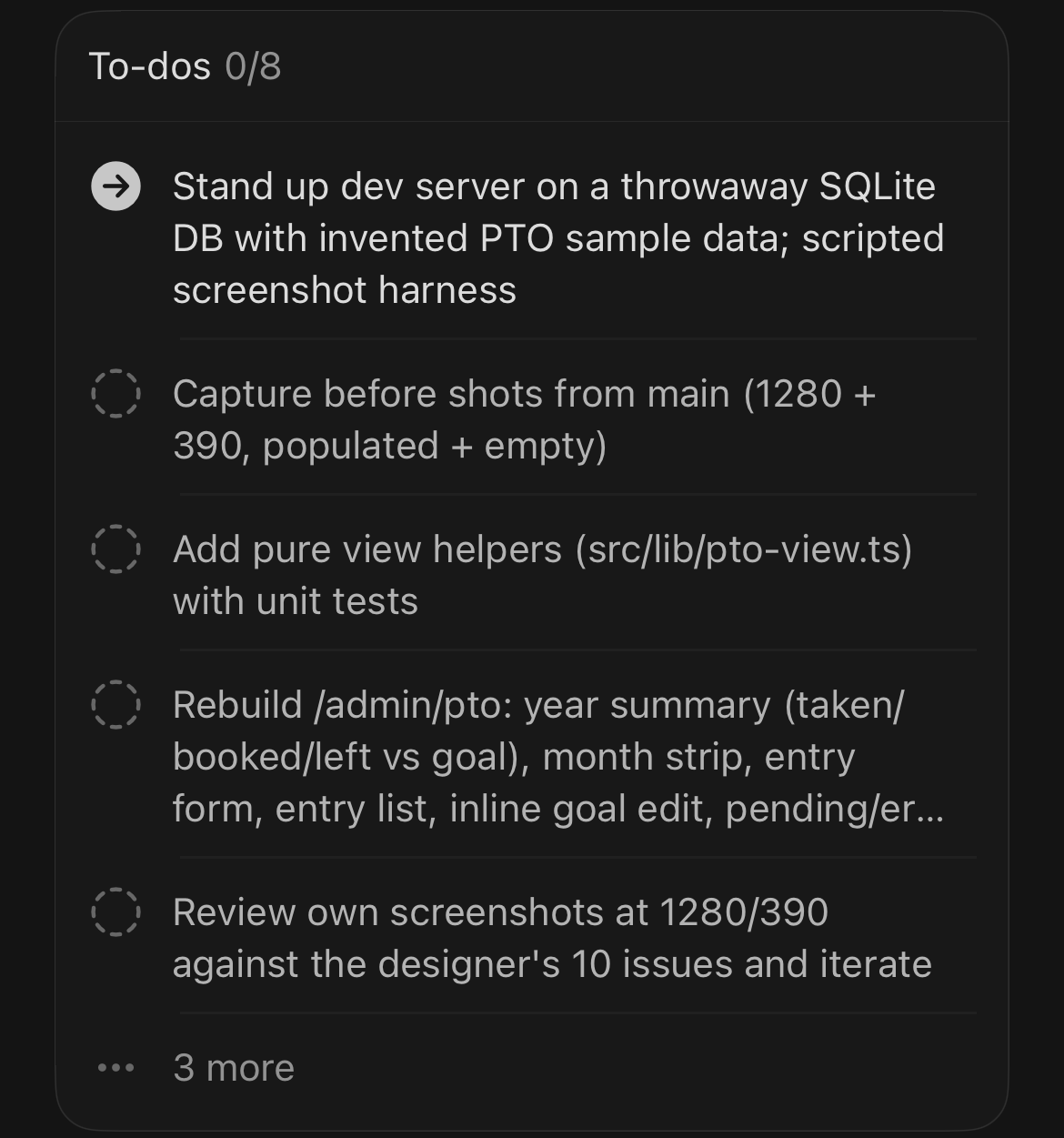
Run 2's to-do list, all 8 still open. Throwaway database, invented data, before shots, and a step to check its own screenshots against the review.
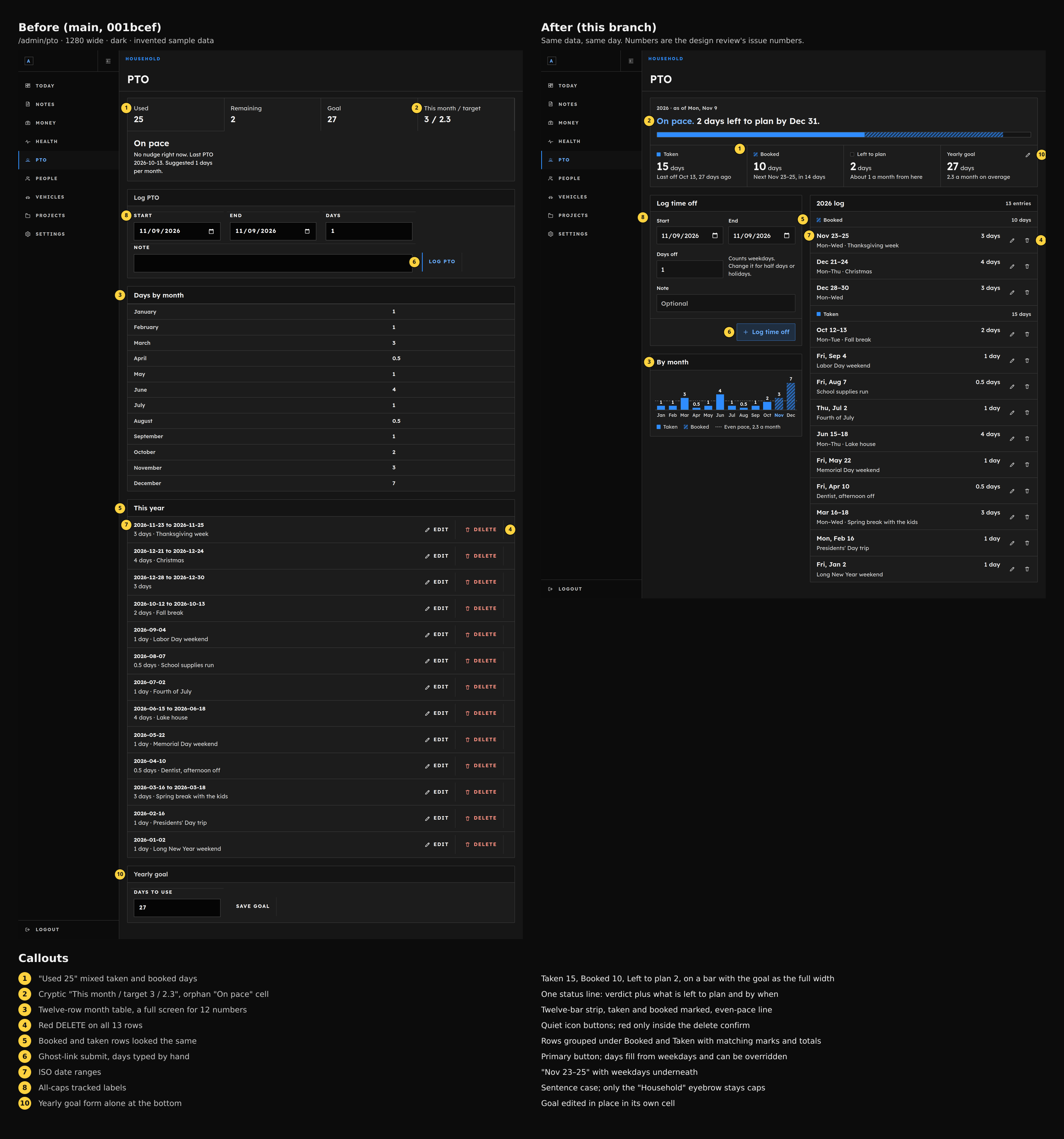
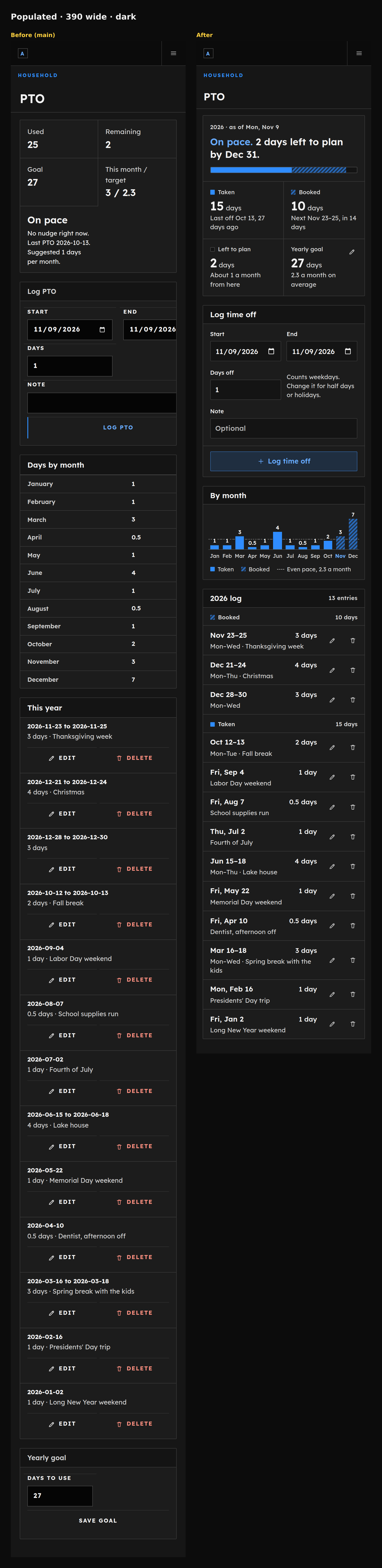
The old headline was basically "Used 25, Remaining 2." The new one says "On pace. 2 days left to plan by Dec 31." with Taken 15, Booked 10, Left to plan 2, and Yearly goal 27 under it, and a goal bar that's solid for taken and hatched for booked. The month table became a little bar chart with an even-pace line. Days off fills in from weekdays. The red buttons are quiet icons now.
The way it worked was just as interesting as the result. It noticed the site only uses a dark color scheme, so instead of inventing a light theme to satisfy the "light/dark screenshots" part of the prompt, it grepped to confirm and then said there's no light theme. And it didn't touch the store at all. All the new logic went into a display-only module.
Partway through, my run 1 PR merged into main. Fable noticed, did a test merge in a separate worktree first to check for conflicts, merged main into its branch, reran everything, and retook the "before" screenshots against the new main so they'd be accurate. It also reused the status helper that run 1 had added instead of writing its own.
It found a real rounding bug in the store too. With uneven day shares, the leftover could come out as a tiny positive number, so the page would say "On pace" when you'd actually hit your goal. It fixed the page to decide from the rounded number, and since it had been told not to touch the store, it left the store alone and flagged the bug as a follow-up.
The checks: tests went to 260 (39 new), 9 mutation checks that each made the tests fail, and 55 scripted browser assertions at 1280 and 390 wide. The PR logged 13 things it got wrong and fixed. One I liked: it changed the over-goal color away from red, because going over your PTO goal isn't really a problem. That's a product instinct, not a lint fix.
It also told me what it couldn't do. Its GitHub access was read-only, so the screenshots ended up as public links instead of GitHub attachments, and it said so. The repo doesn't run CI on PRs, so it said the checks were all local runs. It left the Today page's PTO panel alone because that was out of scope, and said so.
This one took a lot longer, about an hour and a half from its first tool call to its last, 241 tool calls, +2943/-375 across 8 files.
My design bot scored the new version against the same screenshots and the same list. 7.8 out of 10, up from 5.8. Every one of the 10 issues was fixed (all-caps labels only mostly). Here's how the categories moved:
Typography 6 to 7.5. Hierarchy 5 to 8. Spacing 6 to 7. Color 6.5 to 8. Iconography 7 to 7.5. Polish 5.5 to 7.5. Clarity 5.5 to 8.5.
Clarity is the one I care about, and it was the biggest jump. The design bot called the new headline the best change on the page. It still had notes: the desktop columns are unbalanced with a big empty area next to the log, there are no screenshots of edge states like off pace or a delete confirm, and the edit and trash icons look small on a phone. Those went into a follow-up issue and I merged the PR.
What it cost
I pulled the real token counts from my Cursor usage export. Fable is priced at $8 per million input tokens, $40 per million output, $10 per million cache writes, and $0.20 per million cache reads.
| Run | Tokens | At API prices | What I actually paid |
|---|---|---|---|
| PTO API | 17.65M | about $12.23 | $0, counted as included usage |
| PTO redesign | 24.87M | about $21.78 | $21.81 on-demand |
| Total | about 42.5M | about $34 | $21.81 |
I'm on Cursor Pro+. The first run got counted as included usage and the second showed up as a real on-demand charge. Fable is a third-party model and isn't part of the included usage on newer plans, so plan on paying for it.
The thing that makes it affordable at all is caching. About 97% of run 1's tokens were cache reads (17.1M of 17.65M), and run 2 was about 96%. The agent keeps re-reading its own context, and at $0.20 per million instead of $8, that's cheap. If those cache reads had been billed as regular input, run 1 alone would have been over $130.
Caveats
This is two tickets on one personal repo. That's not a benchmark. The Grok 4.7 comparison is my own impression from the UI work I've been doing, not a side-by-side test.
A security thing other devs should know about. During run 2, Fable ran ps to check memory and disk, and the agent process's command line included the config for an MCP server I had set up on the cloud agent, API token and all. Fable never used it and called it out in its final message, but the token is now sitting in that agent's transcript. The fix is to rotate it. The bigger lesson is that anything you pass to MCP servers through env vars or command lines is visible to the agent. Treat it that way.
Also, Anthropic keeps Fable's inputs and outputs for 30 days. That's fine for my personal stuff. I'd keep work code out of it unless your company has signed off.
What's next
One thing I keep coming back to is that all of this happened on my phone. Two tickets, a design review before and after, two PRs, and the merges, all through Grok Bot and Cursor cloud agents, and I never sat down at a desk for any of it.
This was the quick test. I want to do the real one next: the same ticket, the same prompt, and the same design-bot scoring across a few models head to head, so I can put actual numbers next to the "way better" feeling. More tests coming.