I was a big Solid fan years ago, when it was still pre-v1. I even tried to get a project at work to switch from Next 12 to Solid and SolidStart.
It stayed in flux for so long that we just stuck with Next. I don't blame us for that. It does mean a switch is a lot harder to justify now than it was then.
On November 17, Solid 2.0 shipped, and NativeScript announced you could build native apps with it. That pulled me back in. I wasn't going to reopen the conversation at work. I did want to try 2.0 myself, on a real project, and see how it actually felt.
I already had one in mind. Gridlock GP is a two-car dice race my son Ben drew on paper, and I have a web version of it on my personal site, built with React 19 and TanStack Start. I almost just did a Solid port on the web, since that's what I do most of the time. I sat with that for a minute. A web port of a game that already works on the web would mostly have proved the bundle was smaller. The new part of this release, and the least tested one, was running Solid 2.0 native. So I rebuilt Gridlock GP as an iPhone app, and I wrote the game logic so a web version later would stay cheap.
The build
I used Claude Code. Research first, then the build on Tuesday, November 18, in a Linux cloud container with no simulator. Type checks, tests, and an iOS bundle only. About 25 minutes from scaffold to the last commit.
I didn't actually run it on a screen until Saturday, November 22, on a Mac, in the iOS 26.3 Simulator as an iPhone 17 Pro. Two layout bugs showed up. Both got fixed. No reactivity bugs.
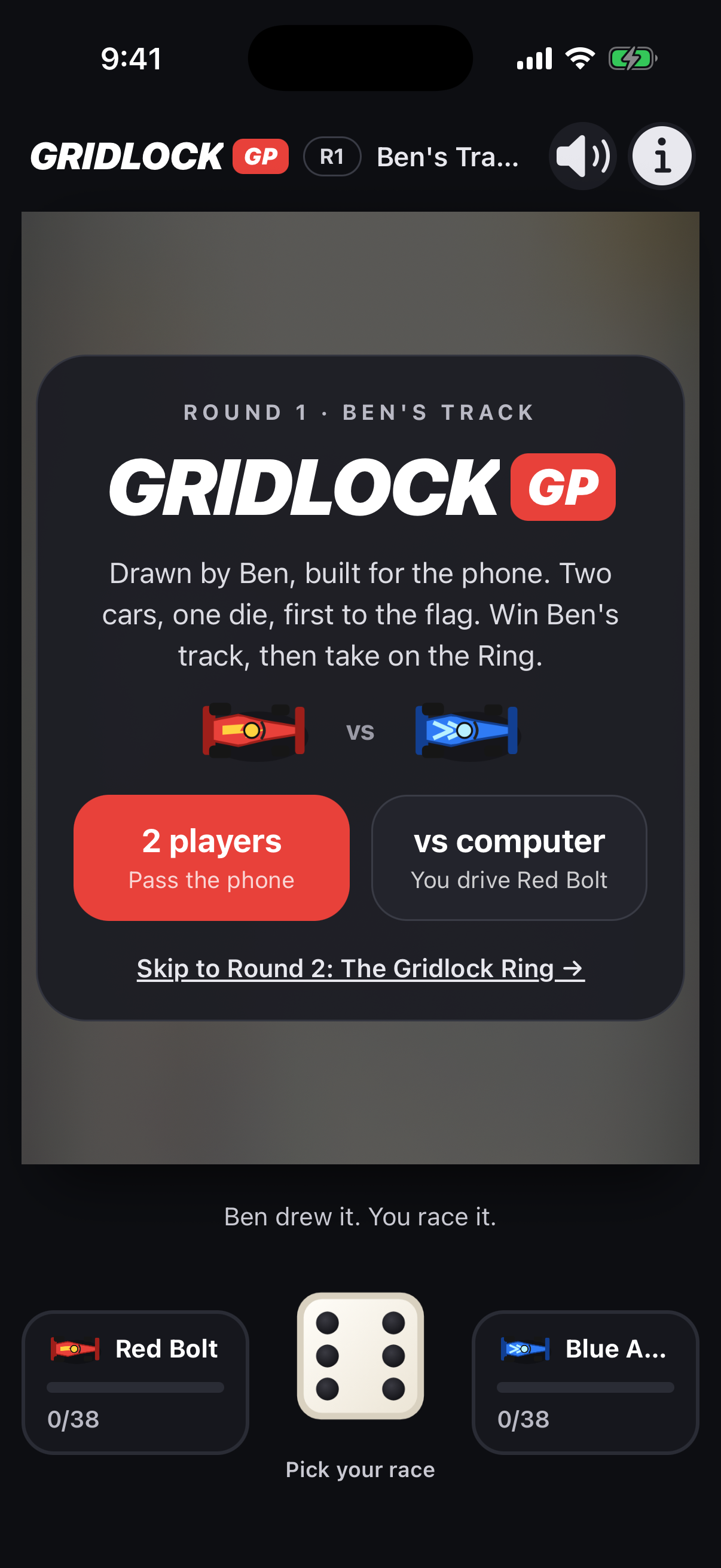
The start screen on the phone. Round 1 is Ben's Track, or you can skip ahead to the Gridlock Ring.
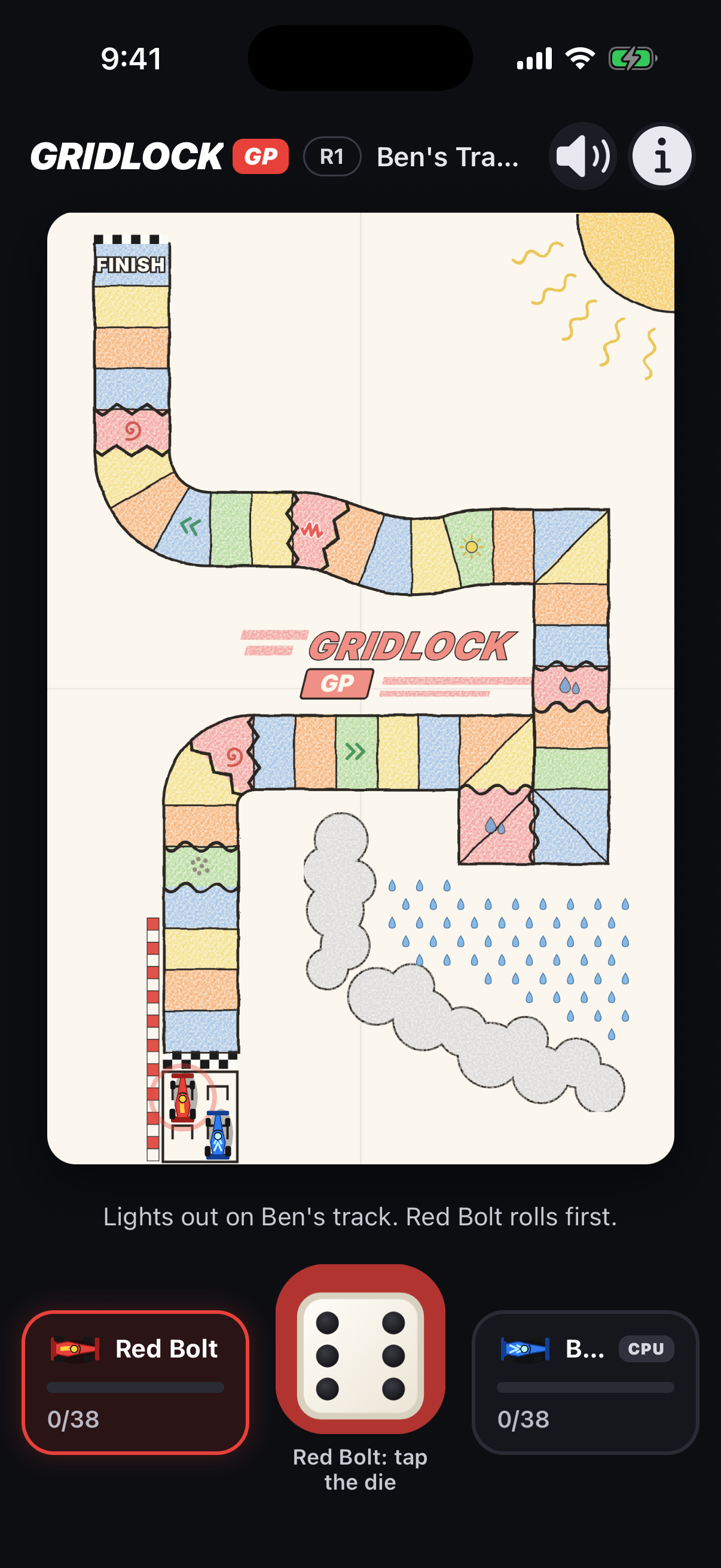
Ben's Track, the one he drew on paper, running on the phone. Red Bolt rolls first.
The shared game rules are 1,127 lines, unchanged from the React version. The Solid controller is 308 lines. The native UI is about 880. There's also about 920 lines of Solid web art tooling, because the board is drawn with Solid on the web, screenshotted to PNG, and dropped into the native app. Same JSX, same signals, two different hosts.
36 Vitest tests, including a full simulated race against the real Solid reactive graph, in 0.7 seconds. The native extras are haptics, native audio, iOS material blur, SF Symbols, confetti, and an on-device FPS readout. No plugins. All of those iOS APIs are called directly from TypeScript.
What worked
Every moving thing in the app, the cars, the die, the hazard ripple, the callouts, the breathing halo, follows one pattern:
createEffect(
  () => carSpot(track(), state.shown, id),
  (spot) => wrap.animate({ translate: spot, rotate: spot.heading }),
)
A store write reaches exactly one effect, which sets exactly one native property, and iOS Core Animation does the rest. There's no virtual DOM and no diff pass between state and UIKit. React Native, NativeScript-Vue, and NativeScript-React all put one there.
The two-argument effect is the best part of the new API for an imperative platform. Watch this, do that, and here's how to stop. That maps one-to-one onto starting an animation loop and canceling it when the turn changes.
All the game state lives outside the UI. One createStore plus a handful of memos, in a plain function called createGridlock(), with no UI imports. It ran under Vitest with fake timers before any UI existed. All 9 controller tests, including a whole race and the computer's turn, passed on their first run. React can do this with an external store, but its default pulls state into components. The React version ended up as a 726-line component with 14 useStates.
The diagnostics are in a class of their own. The first mistake, writing to a store inside createRoot, produced this:
[REACTIVE_WRITE_IN_OWNED_SCOPE] Writing to reactive state inside an owned scope
(component, computation) is not allowed. ...
agent repair guide: node_modules/solid-js/skills/reactivity-diagnostics/SKILL.md#reactive_write_in_owned_scope
Each code has a docs page and a section in a repair guide that ships inside node_modules/solid-js/skills/, next to a Solid 2 primer and a cheatsheet that always match the installed version. For an agent trained mostly on Solid 1.x, that's what made a framework released yesterday workable. Those guides changed two design decisions before any bug got written. Nothing I've seen in the React, Next, or Vue ecosystems is close to this.
Size is still a Solid story, even though 2.0 is a lot bigger than 1.x. People often quoted Solid 1 around 7 KiB. Async in the graph, transitions, optimistic stores, and diagnostics hooks all cost bytes. What this app actually imports, minified and gzipped:
| Runtime | Gzip |
|---|---|
| Solid 2 on NativeScript (signals, store, universal renderer) | 23.5 KiB |
| Solid 2 web, a whole Vite build of the art tool, runtime and app code | 24.1 KiB |
React 19, react plus react-dom/client, runtime alone |
66.7 KiB |
It's still about a third of React. Inside the native app, Solid is about 20% of the JS. NativeScript core is about 60%.
Porting the React SVG to Solid web JSX was mechanical. About 900 lines, mostly strokeWidth to stroke-width.
What was rough
I want to be careful here, because "Solid 2 was hard" and "NativeScript was new" are different conclusions.
Solid itself has a new model with real edges. Reads lag writes, which is right for UI consistency and awkward for an imperative loop that writes and then reads. The turn loop keeps plain-variable mirrors (phase, race, mode), the mirror image of React's stale-closure live ref. Neither framework makes a game loop over reactive state feel fully natural.
action() is the wrong tool for animations. It holds every write until the action settles, so a car driving six spaces would show only the end. The turn had to be a plain async function. This is documented, but the name invites the wrong use.
Effects never compare. An effect re-runs its apply function even when the compute step returned an equal value. The documented fix is gating through a createMemo. It's easy to miss if you're coming from 1.x.
And the node export condition resolves to the SSR build, which renders once and never updates. Tests, and NativeScript's bundler, have to alias Solid to its browser build, or reactive code silently does nothing.
None of these caused a bug in the app. The diagnostics and the bundled guides steered around them. They're what a new teammate would trip on.
The ecosystem is a different story. This is days behind the core. On November 18:
SolidStart's latest, 2.2.3, still requires solid-js ^1.9. There's no Solid 2 SSR meta-framework yet.
Hot reload (solid-refresh) has no Solid 2 release. Edits reload the module and lose state.
The router used by the NativeScript starter, solid-navigation, is alpha. The official template ships a patch-package patch to make it work on Solid 2. I dropped the router.
@solidjs/vite-plugin was fine on Vite 8.3.8, but its peer range lists Vite 9, which isn't published, so vite@^9 fails to install.
@solidjs/testing-library is at 1.0.0-rc.2. I didn't need it, because the state was testable without a renderer.
Most of the friction, and every bug I found on the device, was NativeScript.
Layout is not CSS layout. A <gridlayout> with only columns gets one implicit * row. Inside a vertical stack, that row swallowed the leftover height and pushed the menu buttons to 0 height. A die prompt that wrapped to 1, 2, or 3 lines resized the dock from 205 to 220 to 234pt and rescaled the board on every turn. Unit tests, tsc, and the bundle couldn't catch that. Only a screen could.
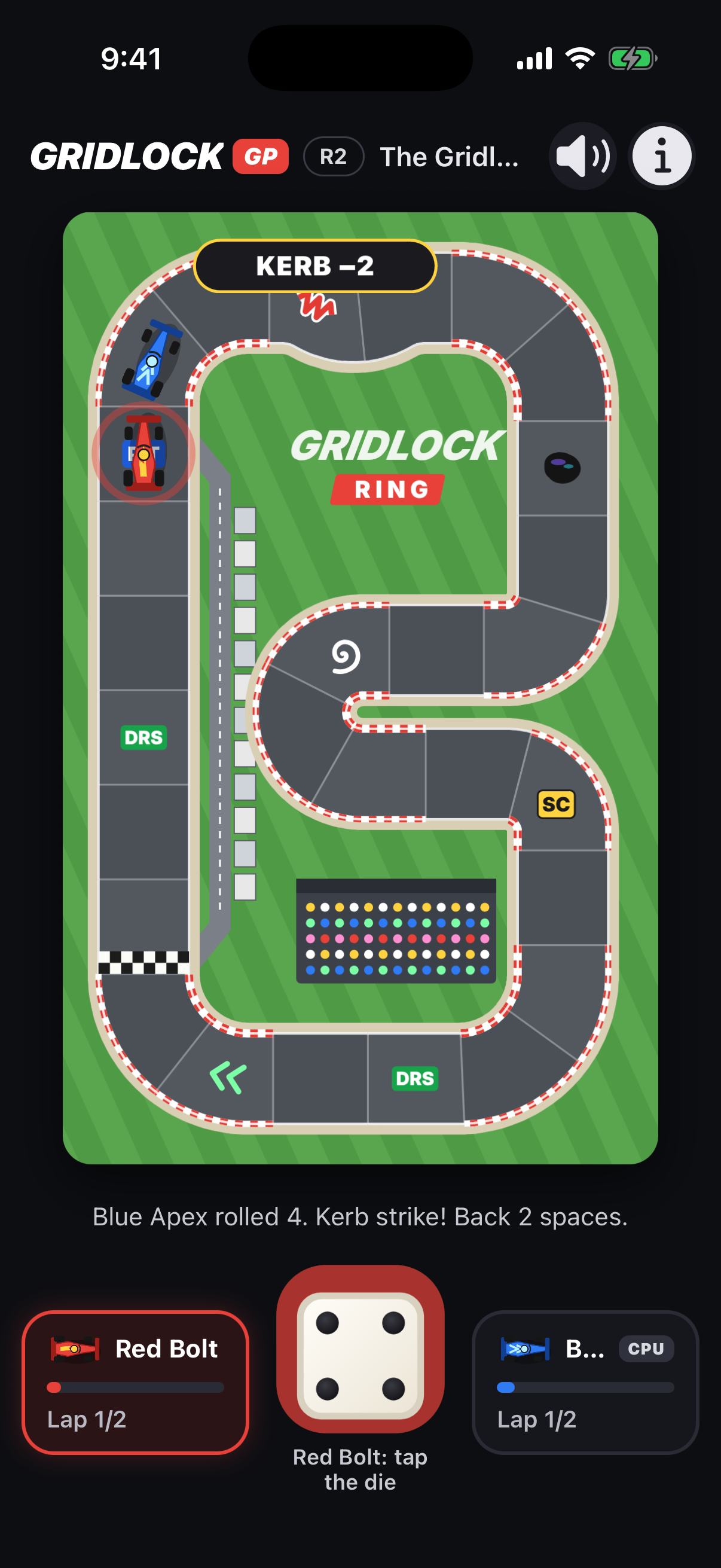
Round 2 on the Gridlock Ring. Blue Apex rolled a 4, hit a kerb, and went back 2 spaces.
CSS fails silently. 22 declarations used the XML attribute names, like text-alignment, instead of the CSS names, like text-align, and they were ignored with no warning. I added a lint script that checks every property against what NativeScript actually registers.
The bundler includes every .ts file under src/, test files too, so Vitest ended up in the app bundle until the tests moved to test/.
Types and runtime disagree. JSX types call elements HTMLLabelElement. At runtime they're NativeScript Labels. That needed one cast helper. Events still use on:tap, where Solid 2 on the web uses onClick.
Mac setup needed five steps that ns doctor didn't mention: xcode-select, the license, -runFirstLaunch, the simulator runtime download, and the xcodeproj gem for whichever Ruby is first on the PATH. The first native build took about 5 minutes.
The upside is real, though. NativeScript calls Objective-C directly from TypeScript. Haptics, audio, and blur each took about 20 to 60 lines, with no plugins.
Where every bug came from
| Bug | Caught by | Source |
|---|---|---|
| Store write in an owned scope (a probe) | Solid dev diagnostic, instantly | Solid rules, working as intended |
| Player could roll during the CPU's think time | Code review, before any UI | Game logic |
| Vitest bundled into the app | Bundle inspection | NativeScript bundler |
| 22 ignored CSS properties | Self-review against NativeScript source | NativeScript CSS, a web habit |
| Menu buttons at 0 height | Simulator | NativeScript layout |
| Board rescaling every turn | Simulator | Layout design |
| Reactivity bugs reaching the device | - | None so far |
That last row is the one I keep coming back to, at least so far. The first time this ran on a screen, every bug was layout.
The numbers I have
These were measured in the build container, not on a phone.
| Measure | Result |
|---|---|
App JS (bundle.js, app code and CSS) |
56.6 KiB min, 15.6 KiB gzip |
| Vendor JS (NativeScript core, Solid, DOM shim) | 1.44 MiB min, 374 KiB gzip |
| Solid 2 runtime as used | 64.2 KiB min, 23.5 KiB gzip |
| React 19 runtime, for comparison | 213.6 KiB min, 66.7 KiB gzip |
| Production iOS JS build | 10.8 s (dev: 3.7 s) |
| 36 tests | 0.7 s |
tsc --noEmit |
about 2 s |
| Art and sound export (31 PNG, 5 WAV, 19 icons) | about 5 s |
| First native Xcode build, on a Mac | about 5 min |
What I don't have yet is the stuff that would make the performance claim land: time to first frame, min FPS across a race and the confetti, animation hitches, memory after 10 races, app size, cold launch. Those still need a Simulator run and a physical iPhone. Haptics and real frame pacing only exist on the device. I want those numbers before I get too loud about how it feels to play.
Against what I usually use
For a one-screen game, TanStack Start's routing, SSR, head tags, and server functions don't buy much. They matter a lot on a real website. For app-shaped products, TanStack plus React is still the safer choice today. The moment SolidStart runs on Solid 2, that comparison needs a re-run.
Next's strengths, RSC, caching, image and edge, do nothing for a client-only interactive app, and it carries the largest runtime of this set. It's the default for content sites, and the least interesting choice here.
For something this size, plain JS and SVG would be the smallest web version. The game rules never needed a framework. Solid earns its keep in the UI bookkeeping, who's active, prompts, panels, overlays, and its version of that is the closest of the frameworks to plain JS that updates itself.
I didn't build a React Native or Expo version, so this isn't a fair head-to-head. Expo's tooling, OTA updates, and ecosystem are far ahead. Solid plus NativeScript wins on the runtime model and on calling iOS APIs directly.
Would I use it again
Yes, now, for interactive, animation-heavy, or state-heavy client UIs. Games. Widgets and embeds where bytes matter. Native side projects through NativeScript. And anywhere I'll be working with an AI agent, because the diagnostics pay off immediately.
Not yet for SSR or content sites, since SolidStart doesn't run on 2.x. Not yet for a team product that needs a deep component ecosystem, or for a team that doesn't have time to absorb a new model and a thin toolchain.
I'd re-check in Q1 to Q2 2027, once SolidStart 2, Solid 2 hot reload, a stable testing library, and a Solid 2-native router for NativeScript have had time to show up.
If I did it again, I'd keep state out of components. A createX() function holding a store and memos, with side effects passed in, made this app testable without a device and portable between renderers. That's the habit worth keeping. I'd also point the agent at the bundled skills in node_modules/solid-js/skills/ on day one, and I wouldn't silence a diagnostic code.
On NativeScript, a few things I'd do immediately: rows="auto" on any grid inside a stack, fixed heights for anything whose text changes in a layout that others depend on, lint the CSS, keep tests out of src/, and budget time for first-time Mac setup.
What's next
I want to finish the on-device numbers, on the Simulator and on a physical iPhone.
Then I want to build the Solid 2 web version. The controller and game rules don't care about the renderer, and the art tool already draws the board with @solidjs/web. A DOM UI over the same controller would give a true Solid vs React web comparison on the same game: bundle, Lighthouse, INP, lines of code. That's the strongest data point this project can still produce, and it's probably a day of work.
After that, when SolidStart supports Solid 2, I'd like to rebuild the web game inside a full site and put it next to the TanStack Start version I already have.
I built this with Solid 2.0.1 and NativeScript 9.1. The release is called "The Long Hold." The hold was long. The core was worth the wait. The rest of the stack still has to catch up.